Democratization
Political openings, bargaining & comparative causal reasoning
Why Open the Rules?
If people in power control the rules, why accept a contest they could lose?
A protest grows. A ruler offers a bargain. An election exists, but opponents still refuse to compete. Advise actors in South Korea, Taiwan, South Africa, Poland and Ghana. Predict a response, follow a second decision, then test your explanation against the historical record. Compare two cases and apply what you learned to a new political problem.
Class follows your assigned country set, then comparison and a final application. Explore has optional writing and checks; Practice keeps checks and optional writing. Save a progress backup whenever you need to pause.
For class: download your report when you finish, then submit it through your course website. Downloading does not submit it.
Check the device save message. Backup downloads an editable JSON record; Restore opens it. Print / PDF or Text makes a readable report. Browser saves do not move automatically between these websites.
What you can explore
- Connect pressure or an opportunity to an actor’s possible gain or loss, a decision and a concrete political rule.
- Distinguish documented events and public reasons from inferred motives and invented responses.
- Interpret votes, seats and institutional thresholds with their correct denominators and limits.
- Compare two historical cases, test an earlier claim and apply the explanation with an explicit mismatch and unresolved risk.
TAKE IT WITH YOU
Keep the game. Keep your questions.
Play online or download the self-contained HTML game. No installation or student account is needed.
- Download the game · HTML
- Student guide · printable
- Teaching guide · learning goals, discussion and assessment
- Complete teaching packet · PDF
- Teaching pack · offline game, guides, editable documents and artwork
- Printable assignment · PDF
- Country evidence and source notes
- Original cover art and country illustrations · ZIP
For Class, complete your assigned countries and final comparison/application. Partial reports and JSON progress backups are available while you work. Downloading does not submit work.
What the model leaves open
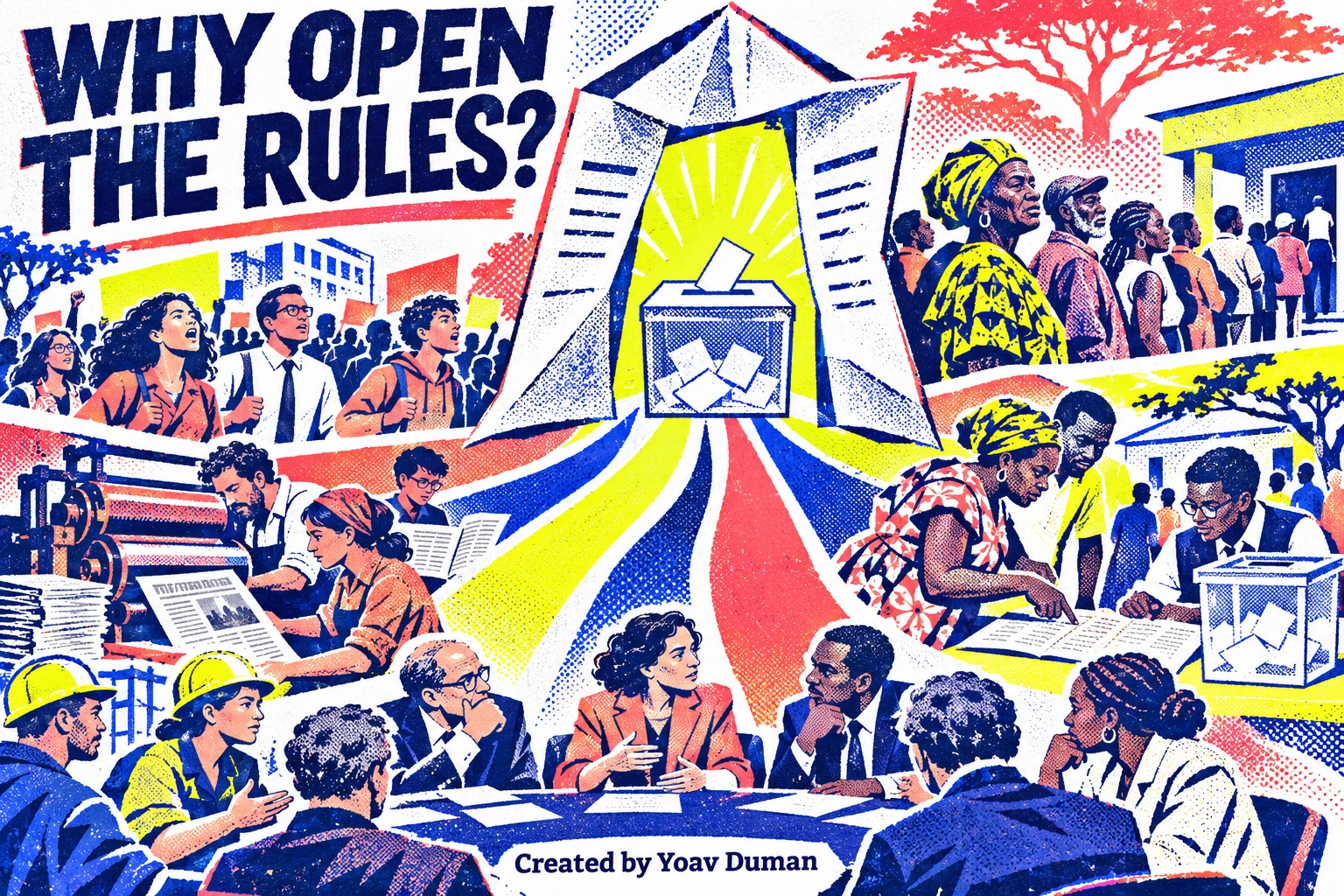
The five country records are historical; branch reactions are simplified invented possibilities and do not change that history. The final Republic of Orvessa is fictional. These selected openings do not establish why similar pressures sometimes fail to produce reform. The activity supports guided reasoning; learning gains and completion times have not been established by a classroom pilot. Cover art is symbolic, not historical evidence.
AFTERWARD, THINK ABOUT
Why might a political opening become acceptable to someone who still wants to stay in power?
Teaching this activity Debrief, assessment & assignment draft
Bring it back to the room
- Why might a political opening become acceptable to someone who still wants to stay in power?
- Where did the rules change while the governing party won, and why does that distinction matter?
- Which protections could reduce the cost of losing, and whose choices would they still depend on?
- Which part of your first explanation did the evidence support, weaken or leave uncertain?
- What can these selected openings not establish about transitions that failed to occur?
What to assess
Assess a clear causal connection, a specific historical detail, the correct number and its limits, a comparison and evidence-based reconsideration. Political advice is not scored. Claim checks provide formative feedback; word minimums check length, not reasoning. Instructors review the explanations.
Read the complete teaching guide →Syllabus description, rubric & printable companion →
Prepare an assignment to share.
Edit this text, then copy it into Canvas or your course website. These edits stay in this tab.
Syllabus description & discussion prompts
Syllabus description
A protest grows. A ruler offers a bargain. An election exists, but opponents still refuse to compete. Advise actors in South Korea, Taiwan, South Africa, Poland and Ghana. Predict a response, follow a second decision, then test your explanation against the historical record. Compare two cases and apply what you learned to a new political problem. Students produce an individual report with predictions, evidence-based revisions, a two-country comparison and a final application.
Questions for a discussion board or class debrief
- Why might a political opening become acceptable to someone who still wants to stay in power?
- Where did the rules change while the governing party won, and why does that distinction matter?
- Which protections could reduce the cost of losing, and whose choices would they still depend on?
- Which part of your first explanation did the evidence support, weaken or leave uncertain?
- What can these selected openings not establish about transitions that failed to occur?