Revolution & regime change
Plan a longer sitting
Revolution, regime change & comparative causal reasoning
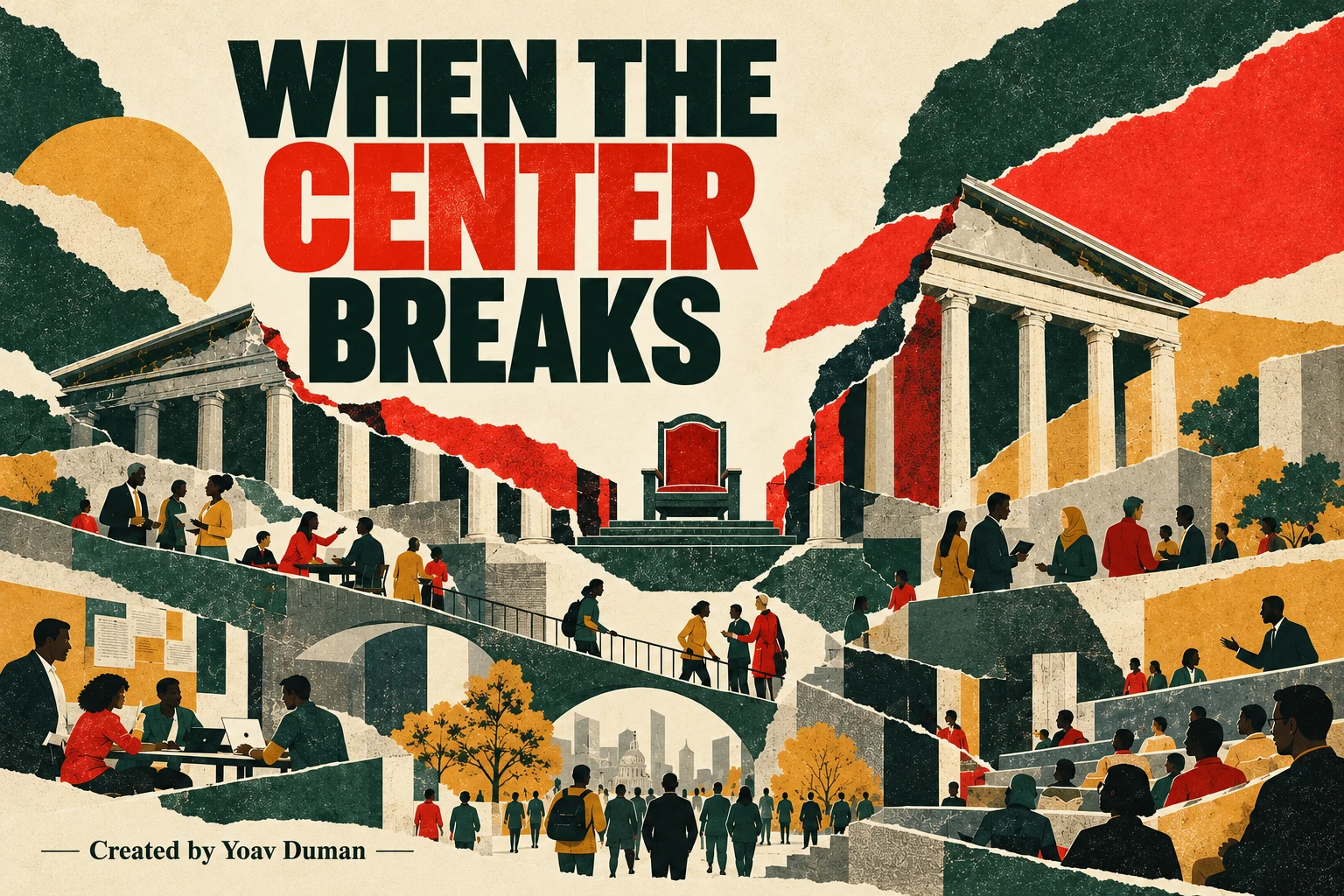
When the Center Breaks
A ruler leaves. What actually changes?
Open real case files from Tunisia, Egypt, Belarus and Sri Lanka. Test theories of revolution, interrogate numbers and sources, and defend what changed in political authority. New evidence may challenge your first explanation.
The same political choices in both routes. You can switch inside without starting over. For class asks you to complete any missing required responses. Save a report in either route; your instructor decides what to accept.
For class: download your report when you finish, then submit it through your course website. Downloading does not submit it.
This activity supports saving on this device. Check its save status before closing, and download a progress backup before changing browsers or devices.
What you can explore
- Distinguish leader exit, regime transformation, democratization and social revolution using dated criteria.
- Connect a theory to actors, actions and a causal mechanism, then compare a serious rival.
- Interpret numbers with their units and denominators; audit sources and preserve evidence-based revisions.
- Transfer an explanation to a new case and propose evidence that could weaken a hypothesis.
YOUR FIELD KIT
Keep the case files.
Play online, download a self-contained copy or take the full teaching pack into class.
- Offline game · HTML
- Complete teaching pack · ZIP
- Student guide · printable
- Instructor manual · PDF
- Sources & references · Case evidence · JSON
Progress is stored separately on each website. Use Save / restore to move your work.
What the model leaves open
Historical events remain fixed; the Commission is fictional. Four purposively selected cases do not estimate revolution success rates. Cover art is conceptual. Timing and learning effects require classroom piloting.
AFTERWARD, THINK ABOUT
Which organizations could keep governing after a leader left, and what evidence supports your explanation?
Teaching this activity Debrief, assessment & assignment draft
Bring it back to the room
- Which organizations could keep governing after a leader left, and what evidence supports your explanation?
- Which observation changed your claim, and which rival remains plausible?
- What can this four-case selection establish, and what would require a different comparison?
What to assess
Assess concepts, mechanism, evidence and data, rivals, revision and uncertainty, and transfer. The manual supplies an 18-point reasoning rubric. Completion and word floors record attempts; they do not grade reasoning.
Read the complete teaching guide →Syllabus description, rubric & printable companion →
Prepare an assignment to share.
Edit this text, then copy it into Canvas or your course website. These edits stay in this tab.
Syllabus description & discussion prompts
Syllabus description
Open real case files from Tunisia, Egypt, Belarus and Sri Lanka. Test theories of revolution, interrogate numbers and sources, and defend what changed in political authority. New evidence may challenge your first explanation. Students produce evidence notebook, independent case brief and testable hypothesis.
Questions for a discussion board or class debrief
- Which organizations could keep governing after a leader left, and what evidence supports your explanation?
- Which observation changed your claim, and which rival remains plausible?
- What can this four-case selection establish, and what would require a different comparison?